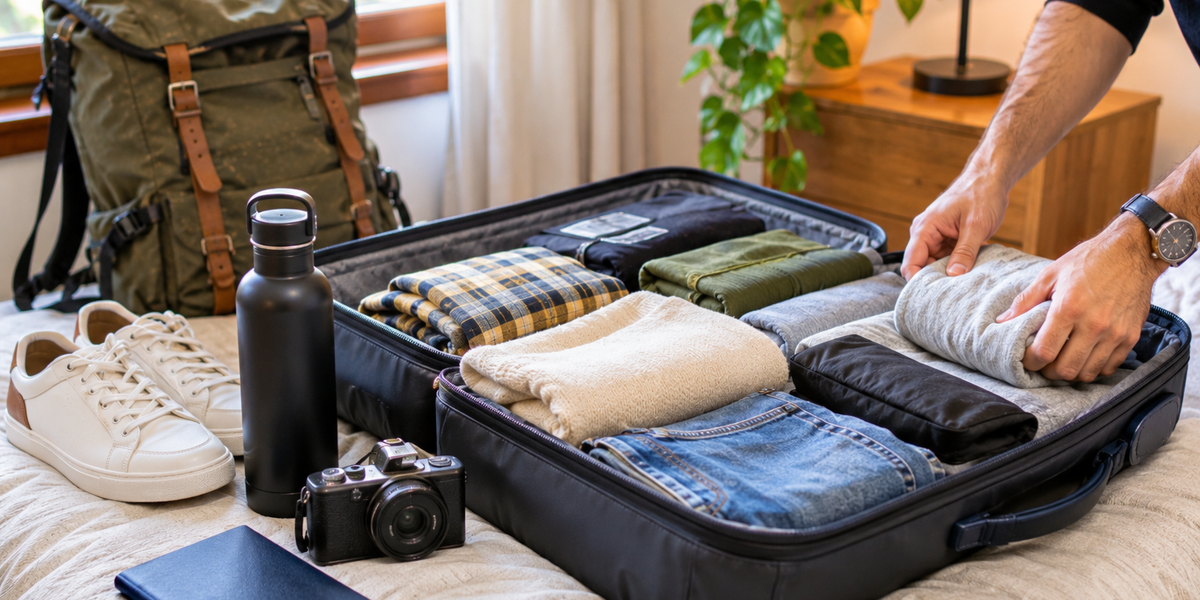
How to Pack Light Without Sacrificing Anything
Packing light sounds wonderful until you are standing over an open suitcase trying to decide whether your second pair of shoes represents sensible preparation or a fundamental character flaw. The advice always seems easy in theory: bring fewer clothes, choose versatile pieces, and take only what you need. Then you remember the nice restaurant you booked, the possibility of rain, the cold evening you were not expecting, the swimsuit you might need, and the fact that you would prefer not to spend your entire holiday dressed in the same black T-shirt.
But packing light does not have to mean traveling with almost nothing. The goal is not to prove that you can survive for two weeks with three items of clothing and a toothbrush. It is to remove the things that take up space without actually improving your trip. Good light packing is less about sacrifice and more about making everything in your bag earn its place.
Pack for the Trip You Are Actually Taking
One of the biggest reasons people overpack is that they pack for imaginary situations. Maybe there will be an extremely elegant dinner. Maybe you will suddenly decide to go hiking. Maybe the hotel has a gym and, despite not visiting your gym at home for three months, this will somehow become the week you exercise every morning.
Before putting anything in your suitcase, look realistically at what your days will involve. If you are spending five days walking around a European city, you primarily need comfortable outfits for walking, something appropriate for dinner, and layers for the weather. If you are going to a resort, you probably need fewer daytime outfits than you think because much of the day will be spent in swimwear. Packing for real plans rather than hypothetical versions of yourself can eliminate an astonishing amount of luggage.
Build Outfits Instead of Packing Individual Pieces
A suitcase can contain plenty of clothes and somehow still contain nothing to wear. This usually happens because each item was packed independently. You liked the shirt, so you packed it. You liked the trousers, so they came too. Only after arriving do you discover that half the pieces do not work together.
Instead, think in complete outfits before anything enters the bag. Every top should ideally work with more than one bottom, and every pair of trousers, shorts, or skirt should work with several tops. Neutral foundations make this easier, but that does not mean your entire suitcase needs to be beige. You can bring color, patterns, and interesting pieces as long as they connect with the rest of what you packed. A smaller wardrobe becomes surprisingly flexible when almost everything can be combined.
Choose a Simple Color Palette
This may be the least exciting packing advice and one of the most effective. Choosing a loose color palette dramatically increases the number of outfits you can create from fewer clothes. If your trousers work with every top and your jacket works with every outfit, you stop needing separate pieces for separate looks.
A simple base of black, navy, white, cream, denim, brown, or another neutral can be combined with one or two accent colors. Accessories can add variety without occupying much space. The point is not to create a perfectly coordinated capsule wardrobe worthy of social media. It is simply to avoid bringing one beautiful green skirt that requires a specific top, specific shoes, and specific jacket that you would otherwise have left at home.
Wear the Bulkiest Things on Travel Day
Some items are worth bringing but terrible at being packed. Boots, sneakers, heavy jackets, thick sweaters, and structured clothing consume enormous amounts of suitcase space.
Wear them.
Your travel-day outfit should generally contain the bulkiest pieces you plan to use during the trip. If you need a winter coat, it does not belong inside your carry-on. If you are bringing boots and lightweight shoes, wear the boots on the plane. If a thick cardigan is coming with you, it can double as an extra layer during an overly air-conditioned flight.
You may look slightly more layered than necessary at airport security, but your suitcase will thank you.
Be Ruthless About Shoes
Shoes are where light-packing ambitions go to die.
They are bulky, awkwardly shaped, and usually much heavier than clothing. Worse, we tend to pack shoes for possibilities rather than reality. Running shoes in case we exercise. Heels in case somewhere is elegant. Sandals for the beach. Comfortable sneakers for walking. Another pair of sneakers because they look better with certain trousers.
For most trips, two or three carefully chosen pairs are enough. One should handle the majority of your walking. Another can cover dinners or slightly smarter occasions. A third may be justified for a specific purpose such as hiking, swimming, or formal events.
The trick is choosing shoes that work across categories. Comfortable leather sneakers can handle sightseeing and casual dinners. Simple sandals can work at the beach and with an evening dress. The more specialized the shoe, the harder it should have to argue for its suitcase space.
Bring Layers Instead of Separate Outfits for Every Temperature
Weather uncertainty causes enormous amounts of overpacking. We see temperatures ranging from 12°C to 24°C and immediately begin packing for both winter and summer.
Layers solve most of this problem.
A lightweight base, sweater or cardigan, and packable outer layer can cover a surprisingly wide range of conditions. Instead of packing thick clothing for cold days and completely different clothing for warm ones, build outfits that can be adjusted throughout the day.
This is especially useful for destinations where mornings are cool, afternoons are warm, and evenings become chilly again. You do not need three wardrobes. You need one wardrobe that can adapt.
Stop Packing a New Outfit for Every Day
Unless you are attending a week of highly photographed events, nobody cares that you wore the same trousers on Monday and Thursday.
Travel clothes can repeat.
A pair of trousers can easily be worn several times. Sweaters, jackets, skirts, and jeans rarely need washing after every use. Even tops can often be reworn depending on the weather and activity.
If you are traveling for more than a week, planning to do one small load of laundry can save more space than almost any packing technique. Ten minutes at a laundromat or using a hotel’s laundry service is often preferable to dragging ten additional outfits across multiple airports and train stations.
Decant Toiletries Instead of Bringing Your Bathroom
Toiletries quietly consume huge amounts of luggage space because we tend to pack containers designed for months of use on trips lasting a week.
You do not need 400 milliliters of shampoo for six showers.
Transfer products into smaller reusable containers or bring travel sizes. Think realistically about how much moisturizer, cleanser, shampoo, conditioner, or other products you actually use each day. The same principle applies to makeup. A trip is rarely the moment when you suddenly start using the seventeen products sitting untouched at home.
Hotels also provide certain basics, and pharmacies exist almost everywhere. You are traveling, not being dropped into an isolated wilderness with no access to toothpaste.
Make Your Personal Item Work Harder
If you are traveling with a carry-on, your personal item is valuable real estate. A well-organized backpack or large tote can hold documents, electronics, medication, chargers, a small toiletry pouch, a water bottle, snacks, and anything you might want during the journey.
It is also the right place for essential items you would struggle to replace if your suitcase were delayed or gate-checked. Keep important medication, identification, valuables, and at least the most essential electronics with you.
The goal is not to stuff your personal item until carrying it becomes miserable. It is to distribute your belongings intelligently rather than treating the smaller bag as an afterthought.
Packing Cubes Help, but They Are Not Magic
Packing cubes are genuinely useful for organization. They keep categories together, make unpacking easier, and prevent your suitcase from becoming complete chaos after you remove one shirt.
Compression cubes can also reduce the volume of bulky clothing.
What they cannot do is make twelve kilograms of belongings weigh seven kilograms.
This distinction matters when flying with strict carry-on weight limits. Compressing clothing may allow you to close the suitcase, but the airline’s scale remains deeply unimpressed by your organizational skills.
Use cubes to organize what you genuinely need, not to create enough room for everything you were supposed to leave behind.
Keep a Small Travel Kit Permanently Packed
One surprisingly effective way to make packing easier is to keep certain travel essentials together between trips. A small pouch can contain a spare charging cable, adapter, luggage tag, basic medication, sleep mask, earplugs, pen, and other tiny items you repeatedly need while traveling.
Do the same with toiletries if you travel frequently.
This reduces both packing time and the anxiety that causes people to throw unnecessary things into their suitcase at the last minute. When the basics are already handled, you can focus on clothing and destination-specific items instead of trying to remember whether you packed a charging cable at midnight before a 6 a.m. flight.
Leave Some Empty Space
A perfectly packed suitcase with absolutely no remaining space feels efficient on departure and becomes incredibly annoying on the way home.
Things expand.
Laundry gets folded less carefully. You buy something. Someone gives you something. You discover local food you want to bring home. Your beautifully compressed packing system somehow refuses to reproduce itself on the hotel floor.
Leaving a little room gives you flexibility. It also makes moving between destinations much easier because you do not need to perform a complicated engineering exercise every time you close the suitcase.
Do the Final “Would I Notice If I Forgot This?” Test
Once everything is packed, look through the suitcase again.
For each nonessential item, ask yourself what would happen if you arrived without it.
If the answer is “I would probably forget I even packed it,” take it out.
If the answer is “I could buy one for €5 if I desperately needed it,” consider taking it out.
If the answer is “this would genuinely affect my trip,” keep it.
This final pass is often where the unnecessary backup outfits, fourth pair of shoes, excessive toiletries, and random just-in-case objects finally disappear.
Packing Light Is Really About Traveling Better
The greatest benefit of packing light is not fitting everything into a smaller suitcase. It is what happens after you leave home.
You move through airports faster. Stairs become less intimidating. Train changes become easier. Cobblestone streets stop feeling like personal attacks. You can get on public transportation without wrestling a giant suitcase through the door. Changing hotels becomes a minor inconvenience rather than a relocation operation.
And perhaps most importantly, you spend less of the trip managing your belongings.
You do not need everything you own to feel prepared. You need comfortable clothes, the essentials, and enough flexibility to deal with whatever actually happens.
The best-packed suitcase is not the one containing the fewest possible things.
It is the one where you use almost everything you brought—and never spend the trip wishing you had left half of it at home.