The Villages That Feel Frozen in Time (In the Best Way)
Some places seem to have negotiated a different relationship with time. Roads narrow into cobbled lanes, centuries-old houses lean toward one another, church bells still organize the day, and the loudest sound in the afternoon might be cutlery from a café terrace. You know perfectly well that Wi-Fi exists behind those stone walls and that someone inside is probably scrolling through their phone, but for a few hours, it becomes surprisingly easy to imagine otherwise.
The most beautiful historic villages are not necessarily places where nothing has changed. In fact, the best ones are usually still lived in rather than preserved purely for visitors. What makes them special is that the old architecture, local traditions, landscape, and slower rhythms have survived alongside modern life. These are the villages where wandering without an itinerary is not something you do between attractions. It is the attraction.
Eguisheim, France
In Alsace, where vineyards roll toward the foothills of the Vosges Mountains, Eguisheim looks almost impossibly storybook-like. Its narrow streets curve in concentric circles around the historic center, lined with brightly painted half-timbered houses, wooden shutters, tiny courtyards, fountains, and flower-filled windows. The village is compact enough to explore without any real plan, which is exactly how you should experience it. Walk slowly, stop for a glass of local wine, look into the small shops, and continue into the surrounding vineyards if the weather is good. Nearby Colmar receives much more attention, but Eguisheim offers a smaller and more intimate version of Alsace that can feel wonderfully removed from modern city life.
Shirakawa-go, Japan
Hidden among the mountains of central Japan, Shirakawa-go is famous for its traditional gassho-zukuri farmhouses, recognizable by their enormous steeply pitched thatched roofs. The design developed partly in response to the region’s heavy winter snowfall, giving the village an appearance that is both beautiful and deeply connected to its environment. In winter, when snow covers the roofs and surrounding mountains, Shirakawa-go can look almost unreal. Yet it is more than a picturesque collection of old buildings. Some of the houses remain homes, while others help visitors understand the agricultural traditions and daily life that shaped the region. The village is particularly rewarding when experienced slowly, before or after the busiest day-trip hours.
Bibury, England
Bibury in the Cotswolds represents the version of rural England that seems to exist permanently under soft afternoon light. Honey-colored stone cottages line quiet roads beside the River Coln, while gardens, small bridges, and surrounding countryside complete the scene. Arlington Row, a line of historic cottages, has become the village’s most recognizable image, but Bibury is better appreciated as part of a slower journey through the Cotswolds rather than a single photographic stop. Walk beyond the famous row, follow the river, and allow the village to become somewhere you experience rather than simply photograph. The charm is in how little seems to demand your attention.
Hallstatt, Austria
Hallstatt may be internationally famous now, but its setting still creates the strange feeling of encountering a settlement from another age. Traditional houses occupy a narrow strip between Hallstätter See and the mountains, with buildings climbing the steep hillside because there was simply nowhere else to put them. The lake, church tower, wooden balconies, and surrounding peaks create one of Europe’s most recognizable village landscapes. The challenge is experiencing Hallstatt outside its busiest hours. Stay overnight or arrive early, and the atmosphere changes dramatically. When the streets become quiet and the lake is still, it becomes easier to understand why people were fascinated by this tiny alpine settlement long before social media turned its viewpoint into a global photograph.
Monsanto, Portugal
Monsanto seems less built on the landscape than trapped inside it. Enormous granite boulders surround and sometimes become part of the village’s houses, with walls, roofs, and narrow lanes constructed around rocks that were clearly not going anywhere. Perched on a hillside in central Portugal, the village rewards anyone willing to climb its steep streets toward the castle ruins above. There are polished historic destinations where every corner appears carefully restored for visitors; Monsanto feels rougher and more organic. Stone dominates everything, and the relationship between the buildings and the landscape gives the village a character that would be almost impossible to recreate deliberately.
Reine, Norway
Reine does not feel frozen in time because of medieval streets or ancient monuments. Its timelessness comes from the relationship between the fishing village and the enormous Arctic landscape surrounding it. Traditional red rorbuer, originally fishermen’s cabins, sit beside cold water beneath mountains that rise dramatically from the Lofoten Islands. Fishing has shaped these communities for generations, and although tourism is now an important part of the local economy, the landscape still determines the rhythm of life. Weather changes quickly, daylight behaves strangely depending on the season, and distances feel different this far north. Reine is the kind of place where simply sitting beside a window and watching clouds move through the mountains can occupy an entire morning.
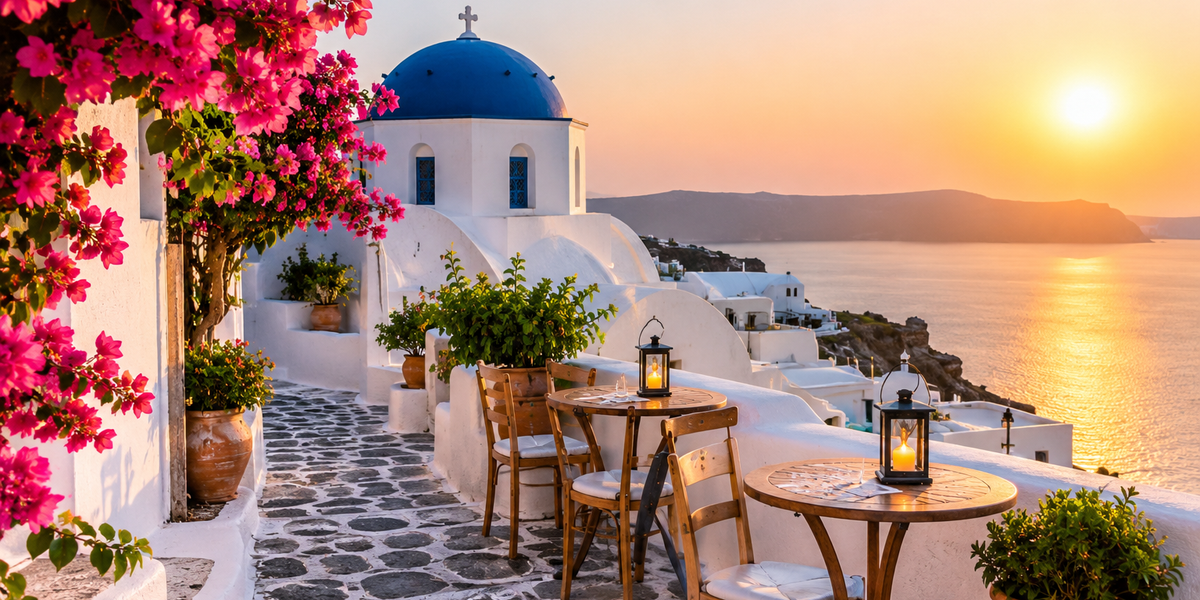
Oia, Greece
Oia is hardly undiscovered, and at sunset in summer it can feel like half the planet has arrived simultaneously. Yet beneath the crowds is a village shaped by a distinctive history and landscape. Whitewashed buildings descend toward the volcanic caldera, blue-domed churches rise between narrow pathways, and cave houses have been built directly into the cliffs. Early morning is when Oia comes closest to revealing its quieter character. Before the day-trippers and sunset crowds arrive, the lanes can be remarkably peaceful, and the architecture becomes easier to appreciate without constantly navigating around photographs being taken. Staying overnight rather than visiting for a few hours makes an enormous difference.
Albarracín, Spain
Surrounded by rugged countryside in Aragón, Albarracín rises across a rocky hillside in a maze of narrow lanes, reddish stone buildings, wooden balconies, defensive walls, and irregular houses that seem to have grown together over centuries. The village has the enclosed, slightly mysterious atmosphere that people often hope to find in medieval destinations but rarely do. Streets twist unexpectedly, buildings lean toward one another, and the surrounding walls climb across the hills above the settlement. Albarracín is particularly atmospheric in quieter seasons, when cold air and nearly empty streets make the historic center feel even farther removed from contemporary Spain.
Giethoorn, Netherlands
Giethoorn offers a completely different version of village life. In its historic center, canals function almost like streets, running between traditional thatched-roof houses, gardens, wooden bridges, and narrow walking paths. Small boats move through the waterways, giving the village a rhythm that feels immediately slower than somewhere designed around cars. Giethoorn has become extremely popular with visitors, so describing it as a forgotten Dutch village would be inaccurate. But walk beyond the busiest central stretches or stay after the main daytime crowds leave and its original appeal becomes much clearer. The landscape forces you to slow down because there is simply no sensible way to rush through a village by tiny boat.
Èze, France
Perched high above the Mediterranean between Nice and Monaco, Èze feels like a stone labyrinth suspended over the French Riviera. Narrow passages twist uphill between old buildings, archways frame glimpses of the sea, and staircases lead toward tiny courtyards, galleries, and terraces. Its dramatic location is as important as its architecture; every so often, the enclosed medieval lanes open onto an enormous view of the Mediterranean far below. Èze attracts plenty of visitors, but early morning and evening can still deliver the atmosphere that makes hilltop villages so addictive. There is something deeply satisfying about walking through streets that were designed for feet centuries before anyone needed to consider parking.
Castle Combe, England
Castle Combe in Wiltshire has become a favorite filming location precisely because very little needs to be done to make it look historical. Stone cottages line the main street, a medieval market cross stands near the center, and a small bridge crosses the Bybrook at the edge of the village. There are no dramatic attractions demanding an itinerary, and that is part of its appeal. You come to walk, look at the architecture, have lunch, explore the surrounding countryside, and enjoy the peculiar pleasure of being somewhere where almost everything seems to match. On a quiet morning, before visitors begin arriving, it can feel remarkably removed from the twenty-first century.
Perast, Montenegro
Perast sits quietly along the Bay of Kotor, surrounded by steep mountains and calm water. Unlike nearby Kotor, which has a larger fortified old town and attracts significant crowds, Perast is small enough that you can walk from one end to the other without much effort. Historic stone palaces and churches line the waterfront, while two tiny islands sit just offshore. The village’s maritime history is visible everywhere, but its greatest attraction is arguably the atmosphere. Sit beside the bay with coffee in the morning or dinner in the evening and there is very little pressure to do anything else. The mountains, stone buildings, boats, and water provide enough entertainment on their own.
Civita di Bagnoregio, Italy
Few villages make arriving feel as dramatic as Civita di Bagnoregio. The historic settlement sits on an eroding hilltop in central Italy and is reached by a long pedestrian bridge crossing the valley below. From a distance, it appears almost detached from the surrounding landscape. Once inside, stone houses, arches, small squares, flower-filled doorways, and narrow lanes create an intimate historic center. The village has become a major visitor attraction, but its unusual geography still gives it a powerful sense of isolation. The landscape is slowly changing around it, adding another layer to the feeling that Civita belongs to a world that cannot last forever.
The Beauty of Places That Refuse to Rush
It is tempting to describe these villages as places where time has stopped, but of course it has not. People still work, children grow up, businesses change hands, buildings need repairing, and residents deal with the same modern inconveniences as everyone else. The difference is that the physical evidence of earlier lives has not been completely erased in the pursuit of something newer.
That continuity changes how you experience a place. You begin noticing small things: worn stone steps shaped by generations of feet, doors that are slightly too small by modern standards, houses built around rocks rather than removing them, roads designed for carts instead of cars, and town squares that still function as gathering places rather than decorative historical features.
Perhaps that is why these villages feel so comforting. They quietly challenge the idea that everything needs to become faster, bigger, newer, and more efficient. Sometimes a place can remain beautiful precisely because it has kept something old, inconvenient, irregular, and human.
And sometimes the best thing you can do while traveling is spend an afternoon somewhere that reminds you there was a world before everyone was in such a hurry.